
What Will the New Packaging Legislation Mean for Home Appliances in 2026?
What Will the New Packaging Legislation Mean for Home Appliances in 2026?
A home appliance may pass CE testing and still face EU market problems if its retail box, inserts, bags, or transport packaging lack PPWR evidence.
From 12 August 2026, the EU Packaging and Packaging Waste Regulation generally applies to home-appliance packaging.I now prepare packaging traceability, substance evidence, technical documentation, and a PPWR Declaration of Conformity before placing covered packaging on the EU market.
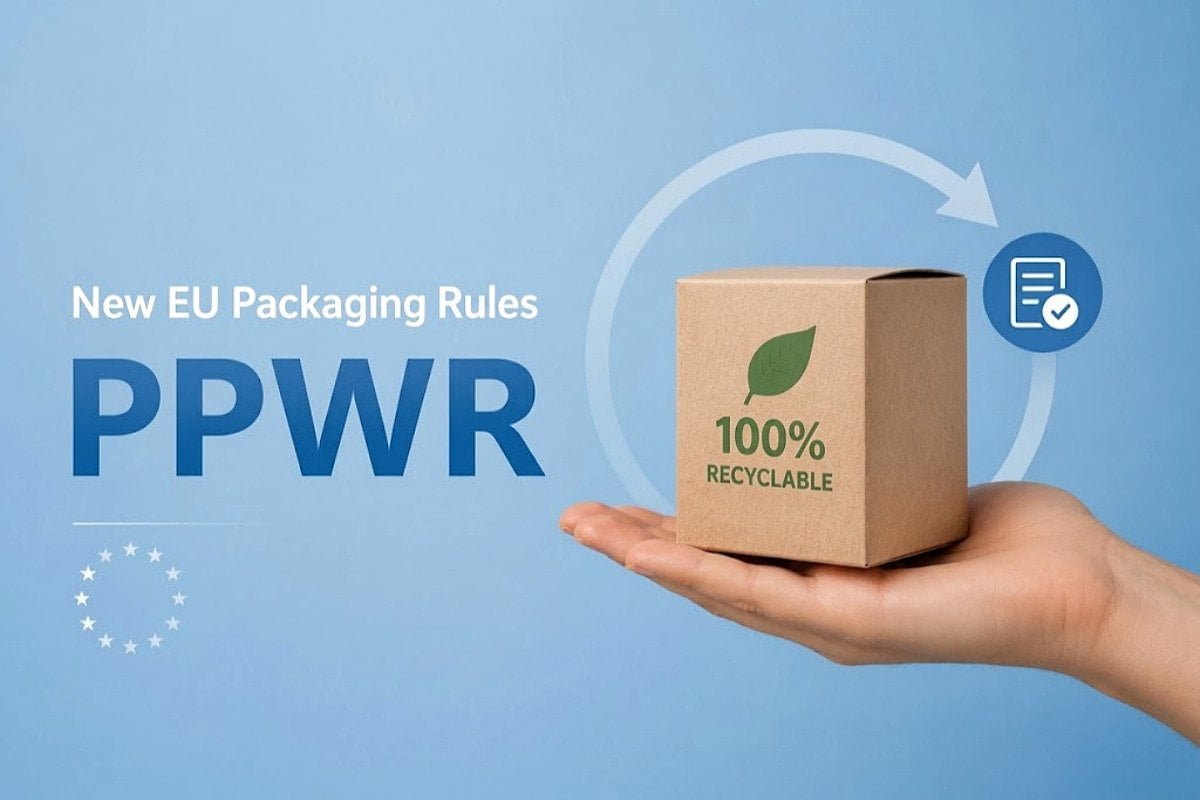
When I prepare a vacuum cleaner for the EU market, I no longer treat the product and its packaging as one compliance item. The appliance needs its own safety and CE documents. The packaging needs a separate PPWR compliance file.
This change matters to manufacturers, importers, brand owners, retailers, and online sellers. Missing packaging evidence can delay customs clearance, interrupt sales, or force an expensive packaging redesign.
Which EU Countries Have Packaging Laws?
Many exporters register packaging only in Germany or France. This creates a compliance gap when the same appliance is sold in several other EU markets.
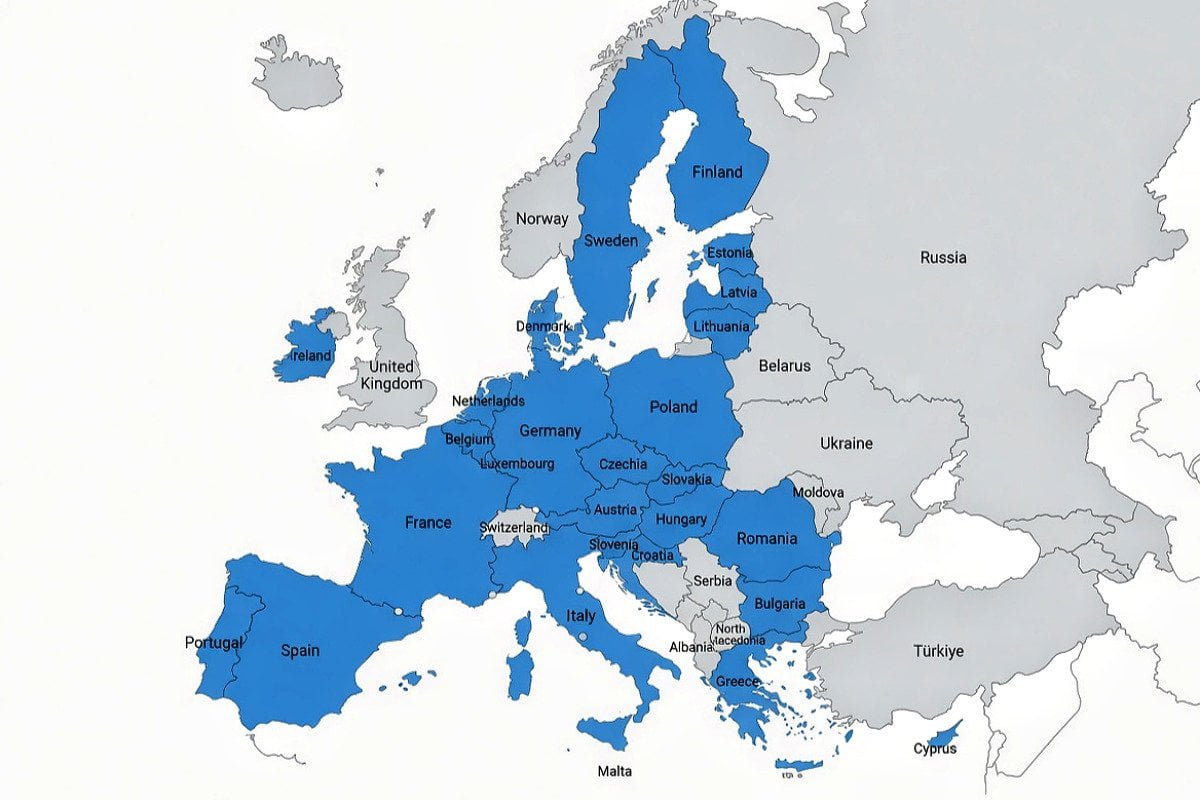
All 27 EU Member States have packaging laws. The PPWR creates a common EU framework, but each country still has national Extended Producer Responsibility registration, reporting, fee, and enforcement requirements.
The PPWR applies directly across the European Union. However, it does not create one central registration account that automatically covers every EU country.
I still need to determine where the packaging will become waste. I then check the national EPR system in each relevant country.
The 27 EU Member States are:
| EU region | Countries |
|---|---|
| Western and Northern Europe | Austria, Belgium, Denmark, Finland, France, Germany, Ireland, Luxembourg, Netherlands, Sweden |
| Central and Eastern Europe | Bulgaria, Croatia, Czechia, Estonia, Hungary, Latvia, Lithuania, Poland, Romania, Slovakia, Slovenia |
| Southern and Mediterranean Europe | Cyprus, Greece, Italy, Malta, Portugal, Spain |
I treat national compliance as a second layer below the PPWR.
Germany still has its national packaging register and compliance schemes. France has EPR registration, a unique identification number, and consumer sorting-information requirements. Italy, Spain, Poland, Austria, and other markets also operate national reporting and fee systems.
The PPWR will gradually harmonise packaging-design and labelling requirements. It will not immediately remove national EPR registrations or packaging fees.
I also do not treat the United Kingdom, Switzerland, or Norway as EU Member States. These markets have separate packaging rules, even when some requirements look similar to the PPWR.
The official list of Member States can be checked on the European Union country page.
What Are the Reporting Requirements Under the EU PPWR?
A packaging BOM stored at the factory is not the same as an EPR report. I first identify the responsible company, the destination market, and the national reporting system.
Under PPWR Article 44, producers must register in each relevant Member State and report packaging data for the preceding calendar year.Reports normally separate packaging by material, weight, category, destination market, and single-use or reusable status.
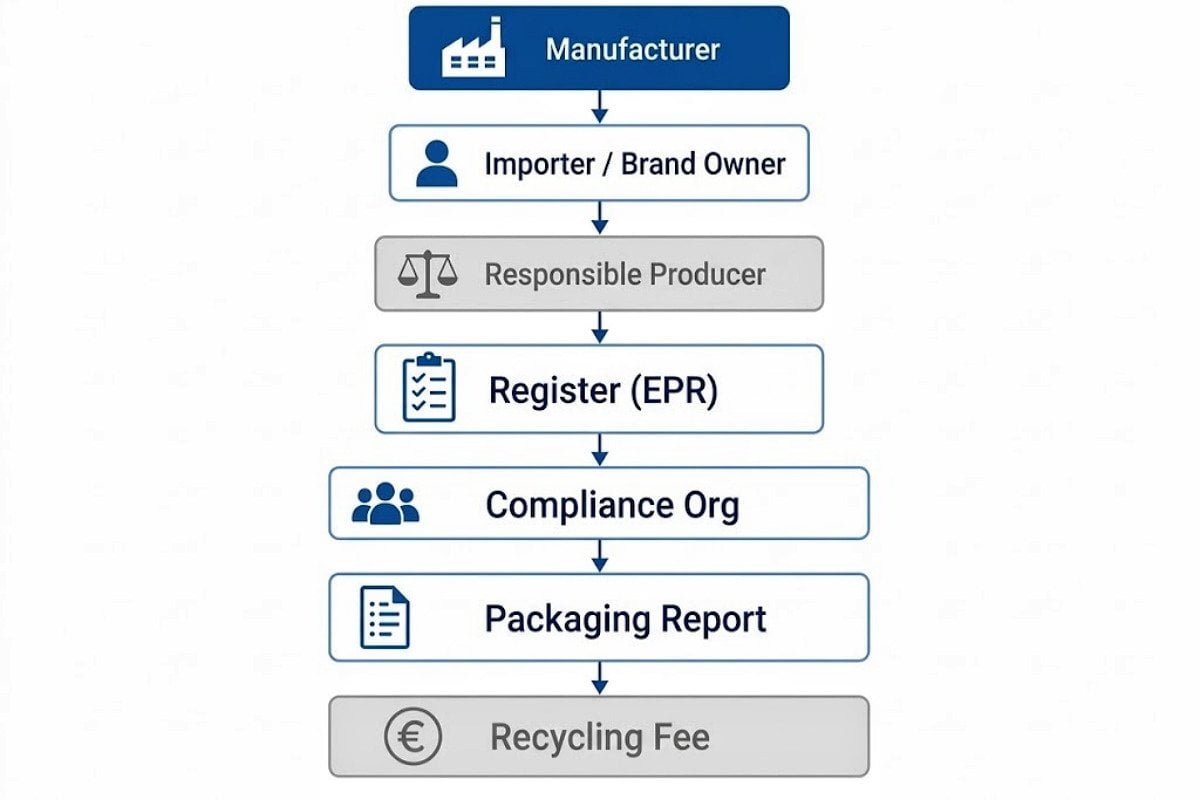
One common mistake is treating the “manufacturer” and “producer” as the same company. Under the PPWR, these roles can be held by different businesses.
| PPWR role | Main responsibility | Home-appliance example |
|---|---|---|
| Manufacturer | Ensures packaging conformity and prepares the technical file and Declaration of Conformity | A brand owner that controls the packaging design and places its trademark on the packaged vacuum cleaner |
| Supplier | Provides material, production, composition, and test information | A carton, plastic bag, pulp tray, EPS, EPE, tape, or label supplier |
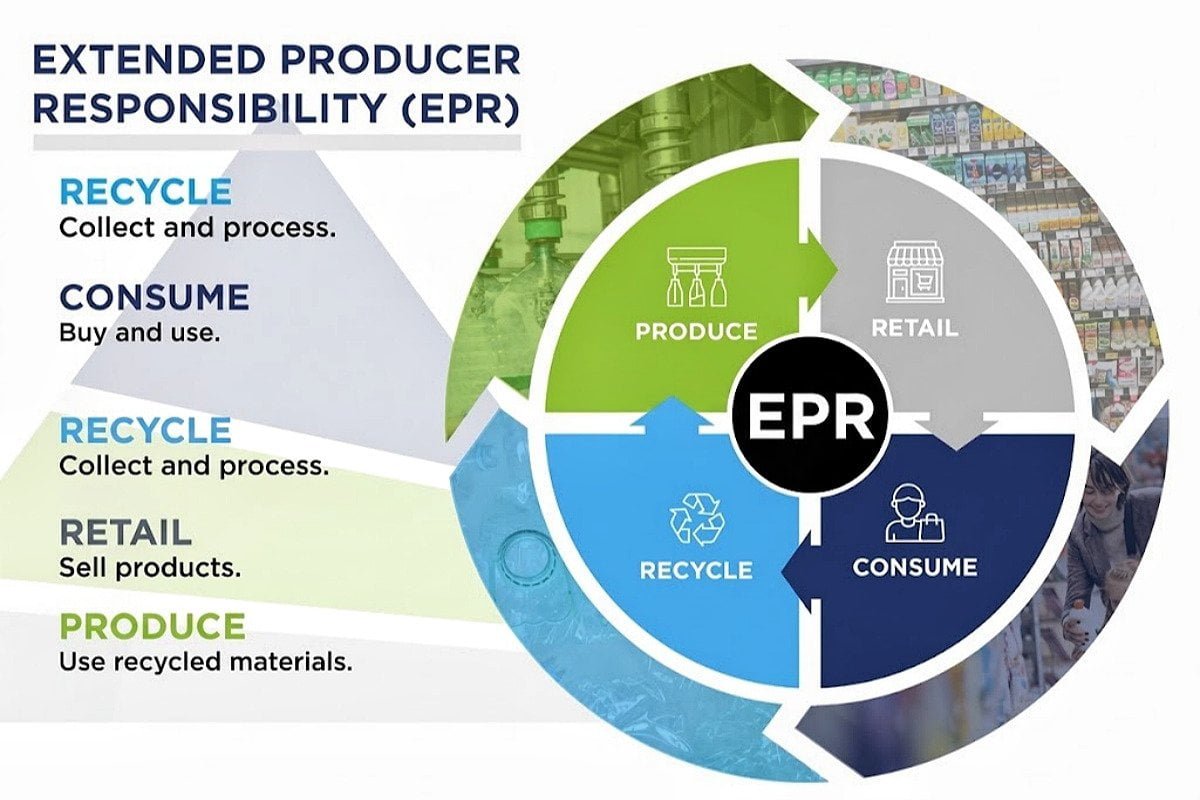
| Producer | Registers, reports packaging quantities, and finances waste management in a Member State | An EU importer selling the packaged appliance in its local market |
| Producer Responsibility Organisation | Collectively manages EPR duties for producers | A national packaging compliance scheme |
The European Commission’s PPWR guidance explains that the manufacturer and producer may not be the same company.
The manufacturer is responsible for packaging conformity with the applicable sustainability and labelling requirements. The producer is responsible for EPR registration, reporting, and financing packaging-waste management in the country where the packaging is expected to become waste.
A national packaging report may require the following information:
- Producer’s legal name and contact details.
- Authorised representative details, where applicable.
- National packaging registration number.
- Producer Responsibility Organisation membership.
- Reporting year and destination Member State.
- Sales, grouped, transport, and e-commerce packaging quantities.
- Packaging weight by material.
- Paper and cardboard packaging weight.
- Plastic packaging weight.
- Metal, glass, wood, and other material weights.
- Single-use and reusable packaging quantities.
- Recycled-content information for plastic packaging.
- Number of rotations for reusable packaging, where applicable.
- Supporting evidence for material and weight declarations.
- Packaging placed on the national market during the reporting period.
Article 44 provides for annual reporting for the previous calendar year. However, a national EPR scheme may still require monthly, quarterly, or annual declarations.
Some Member States may allow simplified reporting for businesses below defined packaging-volume thresholds. I do not treat this as an automatic exemption from registration or EPR fees.
When a Chinese manufacturer sells products to an EU importer, the importer will often become the EPR producer in its local market. When a non-EU company sells directly to EU end users, the foreign seller may become the producer in each destination country.
I therefore define EPR responsibility in the sales contract. I do not simply assume that the importer, marketplace, or distributor will manage it.
What PPWR Requirements Apply from August 2026?
The statement that “PPWR applies in 2026” can be misleading. It does not mean that every recycling and packaging-reduction target became mandatory on the same day.
From 12 August 2026, immediate PPWR duties include substance controls, packaging traceability, supplier information, technical documentation, conformity assessment, and a Declaration of Conformity. Harmonised labels, recycled-content targets, design-for-recycling grades, and stronger minimisation rules start later.
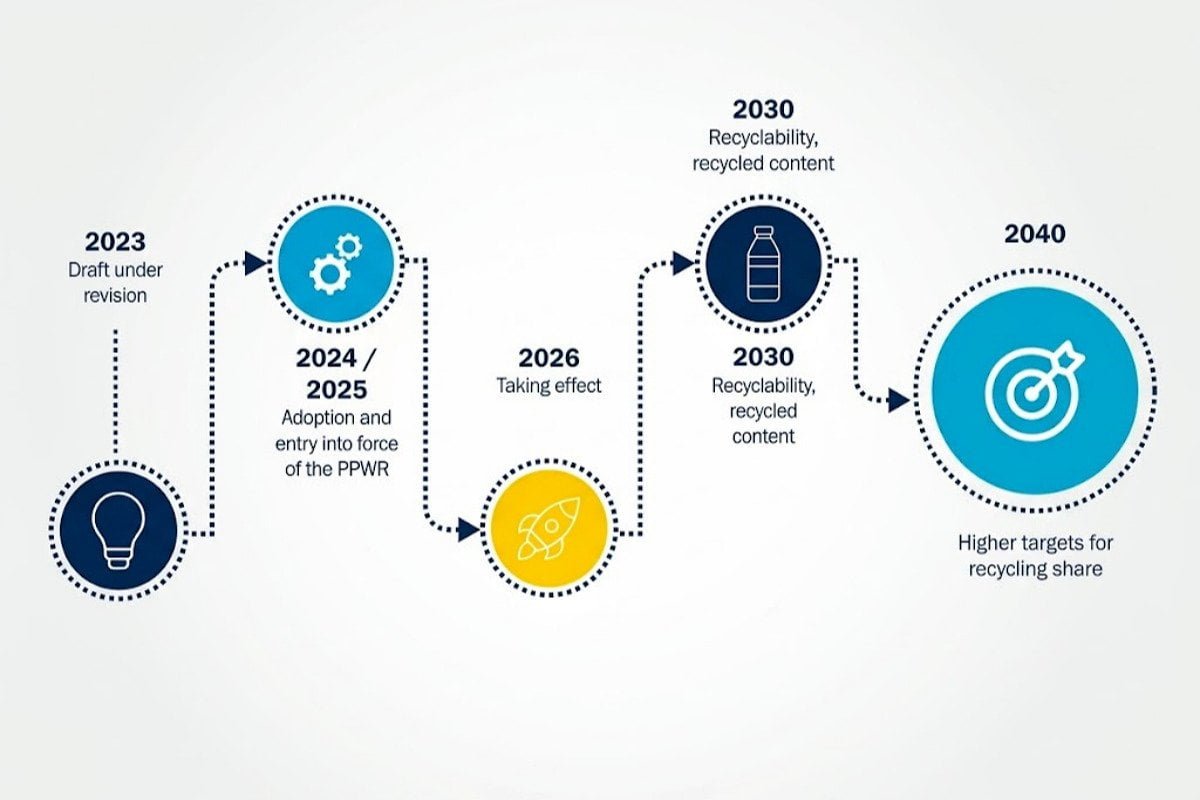
The European Commission confirms that Regulation (EU) 2025/40 entered into force on 11 February 2025 and generally applies from 12 August 2026.
The regulation covers all packaging placed on the EU market. It covers empty and filled packaging, all materials, packaging manufactured in the EU, and packaging imported from other countries.
For a vacuum cleaner, carpet cleaner, steam mop, or other electrical appliance, I review the complete packaging system:
- Retail or sales box.
- Corrugated cardboard inserts.
- Moulded-pulp inserts.
- EPS or EPE cushioning.
- Product protective bag.
- Accessory bags and sleeves.
- Accessory cartons.
- User manual.
- Tape and labels.
- Cable ties and fixing materials.
- Master carton.
- Pallet wrap and transport straps.
The main implementation dates are:
| Date | Requirement | Practical effect |
|---|---|---|
| 12 August 2026 | PPWR generally applies | Covered packaging needs applicable technical documentation, traceability, conformity evidence, and a Declaration of Conformity |
| 12 August 2026 | Substance controls apply | Suppliers should provide chemical declarations or relevant test evidence |
| 12 August 2026 | General recyclability requirement applies | Packaging should be capable of material recycling, subject to transitional assessment rules |
| 12 August 2028, or later when linked to implementing acts | Harmonised material-composition labels | EU pictograms will be introduced for consumer sorting |
| 1 January 2030, or a later linked date | Design-for-recycling grades | Packaging may need to achieve a defined recyclability performance grade |
| 1 January 2030 | Minimum recycled content in plastic packaging | Many plastic bags and plastic cushioning materials may need minimum recycled content |
| 1 January 2030 | Stronger packaging minimisation | Unnecessary layers, false bottoms, and excess packaging volume will be restricted |
| 1 January 2030, or three years after the relevant implementing act | Maximum 50% empty-space ratio | This applies to grouped, transport, and e-commerce packaging |
| 1 January 2035, or a later linked date | Recycling at scale | Packaging must be recycled at scale rather than only being theoretically recyclable |
What Substance Restrictions Apply?
Article 5 requires manufacturers to minimise substances of concern in packaging and packaging components.
The specific PPWR limits on PFAS from August 2026 apply to food-contact packaging. These limits do not normally apply to a vacuum cleaner retail box. However, other chemical requirements may still affect inks, coatings, adhesives, plastic bags, and printing materials.
I therefore request a packaging chemical-compliance declaration from each relevant supplier. Where the material presents a higher risk, I also request an appropriate test report.
Must All Packaging Be Recyclable in 2026?
Article 6 states that packaging placed on the EU market must be recyclable.
However, the Commission’s 2026 guidance explains that the full PPWR design-for-recycling assessment will depend on future delegated acts. Manufacturers do not yet need to apply the final recyclability grades before those rules become applicable.
During the transition, I use existing material-recycling principles and EN 13430 evidence where appropriate.
For a vacuum cleaner package, I prefer structures that consumers can separate easily. I may use a corrugated box, corrugated or pulp inserts, a clearly identified plastic protective bag, and limited tape. I avoid combining paper, plastic, foam, and adhesive in a way that makes separation difficult.
Are the New EU Recycling Labels Already Required?
The new harmonised EU material-composition label is not automatically mandatory from August 2026.
I do not recommend printing an invented PPWR logo on a retail box. A false or unsupported environmental mark may create another compliance risk.
What Is the PPWR Declaration of Conformity?
Some suppliers describe a material declaration or test report as a PPWR certificate. I avoid this description because it hides the legal responsibility carried by the manufacturer.
The PPWR Declaration of Conformity is a manufacturer’s legal self-declaration under Article 39. It confirms that an identified packaging type meets the applicable PPWR requirements and is supported by the technical documentation required under Annex VII.
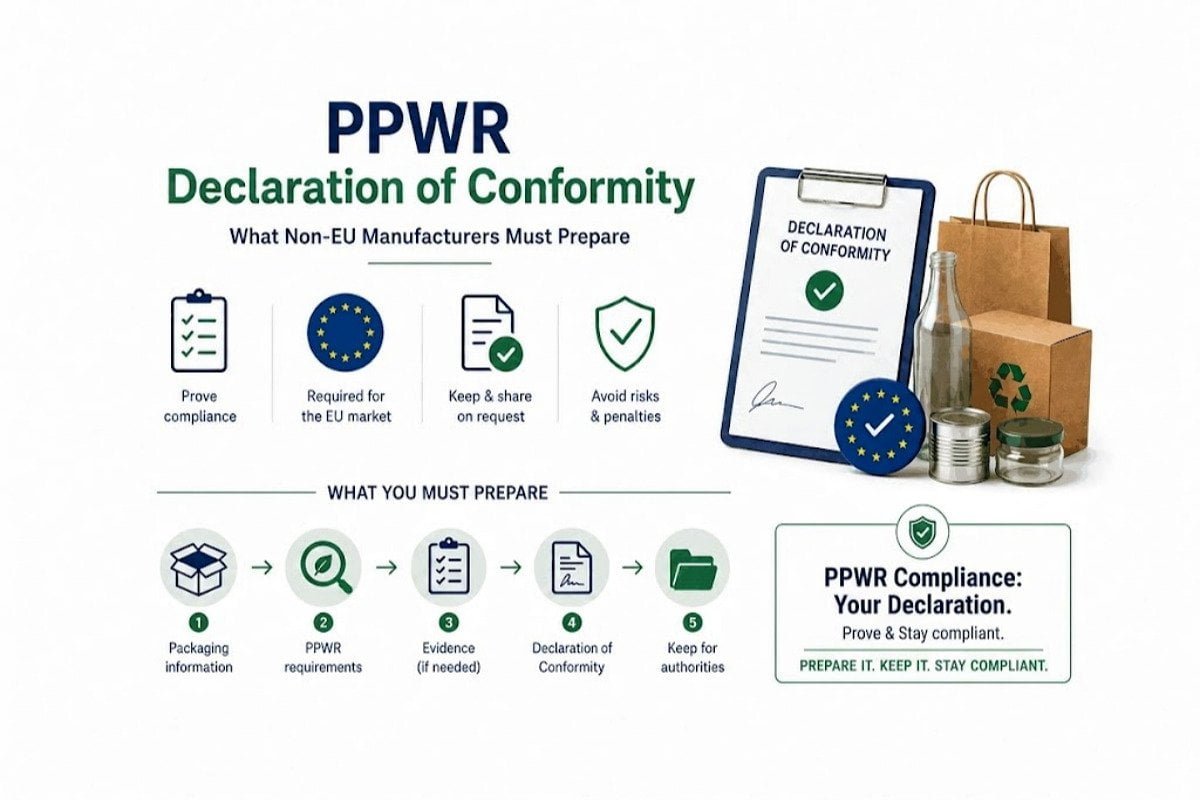
The PPWR Declaration of Conformity is separate from the appliance’s CE Declaration of Conformity.
A vacuum cleaner may need a CE declaration covering electrical safety, EMC, RoHS, and other product legislation. The packaging needs its own PPWR Declaration of Conformity.
The PPWR does not require a CE mark for the packaging itself. It also does not automatically require a notified body or third-party PPWR certificate.
Annex VII uses an internal production-control procedure. A manufacturer may ask a laboratory, consultant, or packaging specialist to conduct tests and prepare evidence. The manufacturer still carries legal responsibility for the final declaration.
The declaration should follow Annex VIII of Regulation (EU) 2025/40.
| Declaration field | Information required |
|---|---|
| Packaging identification | Packaging type, model, drawing number, version, batch, or another traceable reference |
| Manufacturer | Legal company name and full contact address |
| Authorised representative | Name and address when one has been formally appointed |
| Responsibility statement | Confirmation that the declaration is issued under the manufacturer’s sole responsibility |
| Object of the declaration | Description of the box, insert, bag, label, or defined packaging configuration |
| Applicable legislation | Regulation (EU) 2025/40 and relevant PPWR requirements |
| Standards and specifications | Applied EN standards, common specifications, internal standards, and assessment methods |
| Signature | Name, title, place, date, and signature of the authorised person |
I prepare the declaration only after the supporting technical file is ready.
The declaration is not a replacement for test reports, specifications, or supplier evidence. It is the final legal statement supported by those records.
For single-use packaging, the manufacturer must keep the technical documentation and Declaration of Conformity for five years after the packaging is placed on the market.
For reusable packaging, the retention period is ten years.
I also review the declaration when a change in material, supplier, structure, design, or manufacturing process could affect packaging compliance.
Who Must Issue the PPWR Declaration of Conformity?
The physical packaging supplier does not automatically become the responsible manufacturer. I first check whose name appears on the packaged product and who controls the packaging design.
For branded home appliances, the company that has the packaging or packaged product designed or manufactured under its name or trademark will often be the PPWR manufacturer. The packaging converter normally supplies evidence but does not replace the manufacturer’s responsibility.
In an OEM vacuum cleaner project, the EU buyer may control the brand, retail-box artwork, materials, dimensions, inserts, and market specifications. That buyer may therefore become the PPWR manufacturer for the branded packaging.
The carton factory, plastic-bag supplier, and insert supplier must provide the information needed to demonstrate compliance. Their responsibilities may include material specifications, recycled-content evidence, chemical declarations, drawings, and test reports.
The appliance factory must also provide accurate information when it purchases, fills, assembles, or exports the packaging.
The EU importer must verify that the required conformity procedures and documentation have been completed before placing imported packaging on the market.
The exact responsibility can change according to the commercial structure, trademark ownership, packaging design control, and limited micro-enterprise rules. I confirm these roles before finalising the packaging documents.
How Should a Home-Appliance Supplier Prepare a PPWR Technical File?
A supplier questionnaire helps collect packaging data, but it cannot replace the technical assessment, controlled evidence, and signed Declaration of Conformity.
I build one controlled packaging BOM for each appliance configuration. I connect every material, weight, drawing, test report, supplier declaration, and packaging version to the final PPWR Declaration of Conformity.
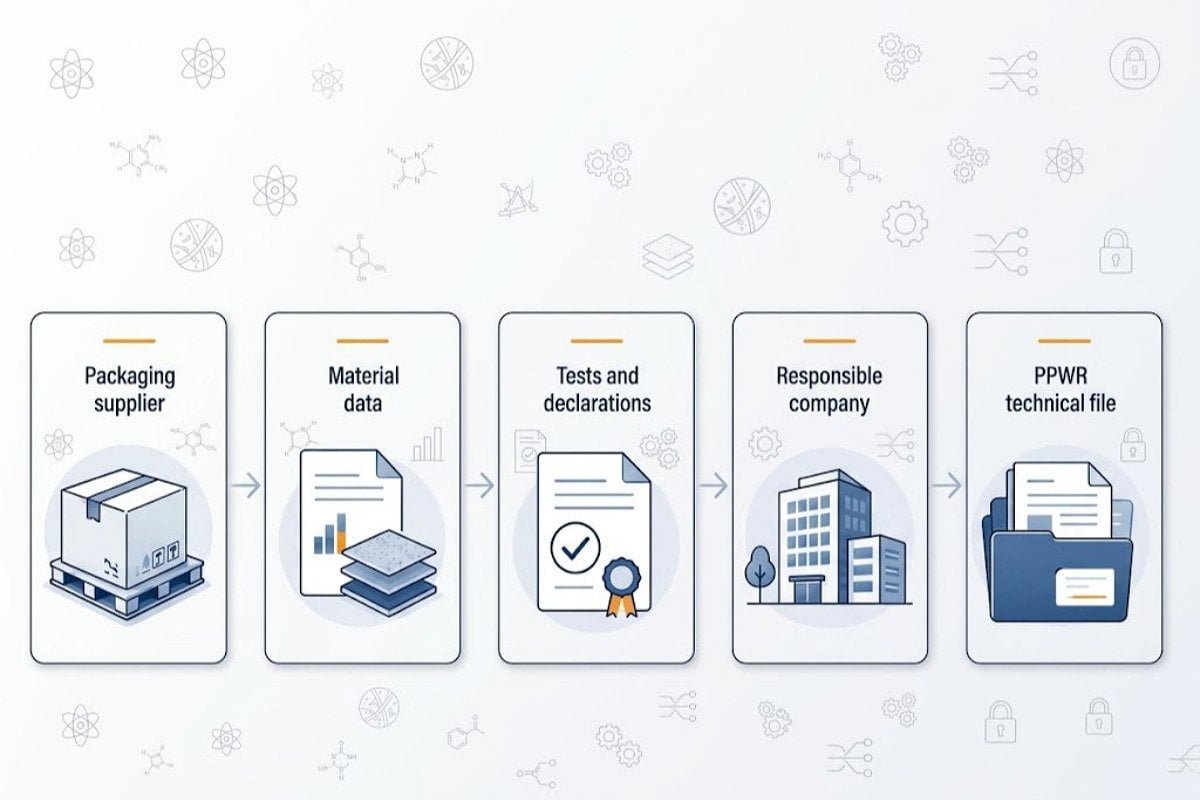
I collect the following information for every packaging component:
| Packaging record | Evidence required |
|---|---|
| Packaging component | Retail box, insert, bag, manual, tape, label, master carton, or pallet material |
| Material and structure | Corrugated grade, paper GSM, LDPE grade, EPS density, EPE structure, adhesive, ink, or coating |
| Dimensions | Length, width, height, thickness, and volume |
| Component weight | Actual weight per packaged product in grams |
| Recycled content | Percentage, calculation method, supplier declaration, and supporting evidence |
| Recyclability | Material-separation method and recyclability assessment |
| Chemical compliance | Supplier substance declaration or test report |
| Drawings and specifications | Controlled document number and revision |
| Performance evidence | Drop, vibration, compression, transport, humidity, or stacking test |
| Responsible parties | Manufacturer, supplier, importer, producer, and EPR representative |
| Target markets | Destination countries, reporting categories, and registration numbers |
In one recent vacuum cleaner packaging review, I found that the supplier form stated a total sales-packaging weight of 6.94 kg. The completed component weights added up to only about 883.1 g before the blank fields were included.
A Declaration of Conformity based on these numbers would be difficult to defend.
I therefore reconcile the total packaging weight against every individual component before approval. I also replace blank cells, unexplained codes, and unclear “N/A” entries with traceable information.
If a component is not used, I record “not used.” If information is pending, I record the responsible supplier and expected completion date. I never treat missing information as evidence of compliance.
I also connect the packaging file to change control.
A change in plastic-bag thickness, paper grade, insert structure, printing ink, tape, or master-carton supplier may affect the technical assessment. I review the packaging file before approving the change for mass production.
This control is especially important for OEM and private-label appliances. One vacuum cleaner model may use different boxes, languages, inserts, manuals, and accessories for different buyers.
What Should Home-Appliance Buyers Request from Their Suppliers?
A statement that packaging is “eco-friendly” does not prove PPWR compliance. I request measurable data and traceable supporting documents.
I ask suppliers for a complete packaging BOM, component weights, material specifications, recycled-content evidence, substance declarations, drawings, test reports, and change-control records. I then check whether every document matches the final mass-production packaging.
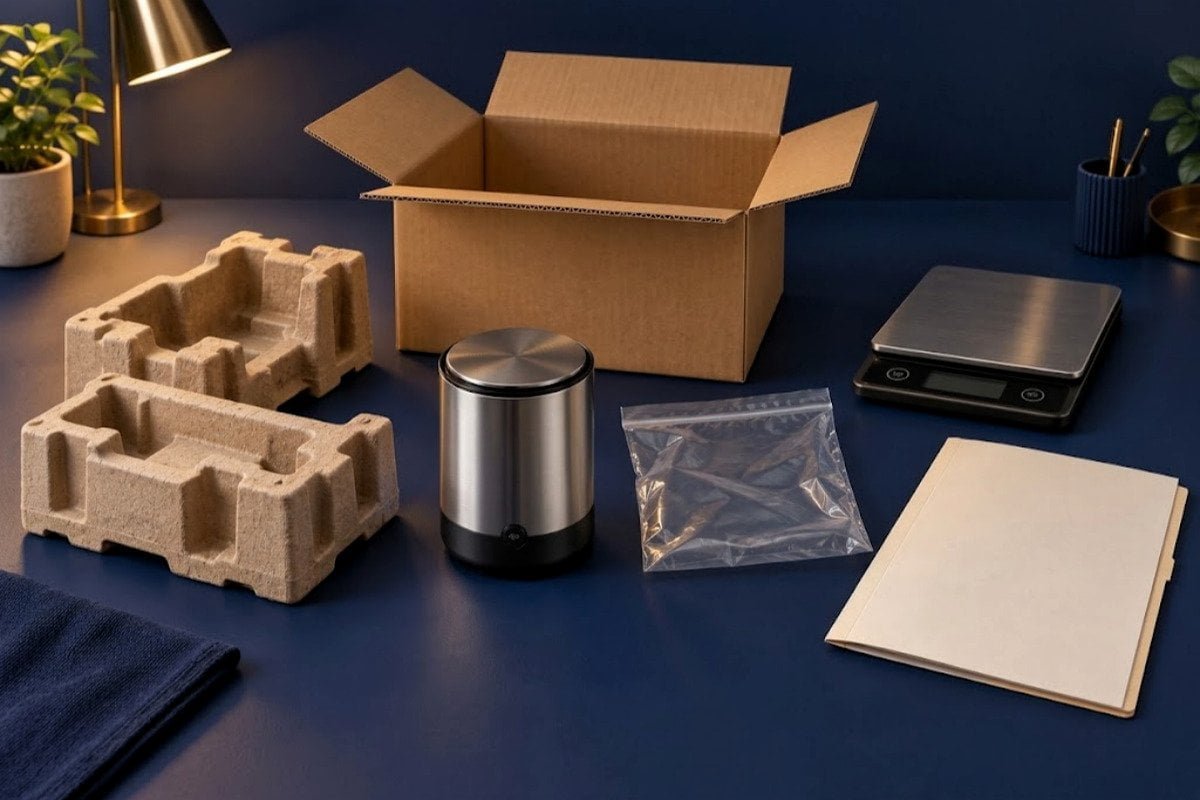
My basic supplier request includes:
- A list of every packaging component.
- Material name and material grade.
- Dimensions and thickness.
- Actual weight per packaged appliance.
- Recycled-content percentage.
- Evidence supporting recycled-content claims.
- Recyclability information.
- Substance-of-concern declaration.
- Heavy-metal compliance evidence.
- Packaging drawings and specifications.
- Drop and transport test reports.
- Packaging version and production date.
- Supplier name and contact person.
- Signed confirmation that the information reflects the actual production packaging.
I do not approve the PPWR file based only on artwork, photos, or a general supplier statement.
The retail box shown in a drawing must match the box used for mass production. The protective-bag thickness must match the supplier specification. The insert material must match the declared structure. The total packaging weight must match the sum of the component weights.
This process gives the manufacturer evidence for its Declaration of Conformity. It also gives the importer or producer accurate packaging weights for national EPR reporting.
The European Commission’s PPWR FAQ should be checked together with the regulation and the applicable national EPR guidance.
Conclusion
I treat PPWR as a packaging data and responsibility system, not only a recycling rule. Clear roles, verified weights, supplier evidence, and controlled documents protect EU market access.
[^1]: "Regulation - EU - 2025/40 - EN - PPWR - EUR-Lex - European Union", https://eur-lex.europa.eu/eli/reg/2025/40/oj/eng. Regulation (EU) 2025/40 entered into force on 11 February 2025 and, under Article 71, generally applies from 12 August 2026, including to packaging used for home appliances. Evidence role: general_support; source type: government. Supports: The PPWR generally applies to home-appliance packaging from 12 August 2026.. Scope note: Individual provisions may specify later application dates or depend on delegated or implementing acts. [^2]: "Packaging waste - Environment - European Commission", https://environment.ec.europa.eu/topics/waste-and-recycling/packaging-waste_en. EU packaging and waste legislation requires implementation and enforcement throughout the 27 Member States, although the resulting national statutes, registration procedures, and competent authorities differ by country. Evidence role: general_support; source type: government. Supports: Every EU Member State has a national legal framework governing packaging and packaging waste.. Scope note: EU-level sources establish Member State obligations but may not catalogue every current national packaging law or administrative procedure. [^3]: "[PDF] EUROPEAN COMMISSION Brussels, 5.6.2026 C(2026) 3702 final ...", https://eur-lex.europa.eu/legal-content/EN/TXT/PDF/?uri=PI_COM:C(2026)3702. The PPWR requires each Member State to maintain a producer register and implement extended producer responsibility, while national authorities retain responsibility for registration procedures, reporting administration, financing arrangements, and enforcement. Evidence role: mechanism; source type: government. Supports: Packaging EPR continues to involve Member State-level registration, reporting, financing, and enforcement.. Scope note: Specific fees, reporting frequencies, exemptions, and enforcement practices remain dependent on national law and implementation. [^4]: "[PDF] Regulation (EU) 2025/40 of the European Parliament ... - EUR-Lex", https://eur-lex.europa.eu/legal-content/EN/TXT/PDF/?uri=OJ:L_202500040. Article 44 of Regulation (EU) 2025/40 provides for a register of producers in each Member State and requires registration in the Member State where packaging is first made available, rather than establishing a single Union-wide registration account. Evidence role: mechanism; source type: government. Supports: The PPWR does not establish one central registration account valid automatically in every Member State.. [^5]: "[PDF] Regulation (EU) 2025/40 of the European Parliament ... - EUR-Lex", https://eur-lex.europa.eu/legal-content/EN/TXT/PDF/?uri=OJ:L_202500040. Article 44 and Annex IX of Regulation (EU) 2025/40 require producers to register with the competent national register and submit specified information on packaging made available in the Member State for the preceding calendar year. Evidence role: general_support; source type: government. Supports: Producers must register in relevant Member States and provide packaging data relating to the preceding calendar year.. Scope note: The precise submission channel, deadlines, reporting frequency, and any permitted simplifications may be further defined nationally. [^6]: "Packaging and packaging waste (from 2026) | EUR-Lex", https://eur-lex.europa.eu/EN/legal-content/summary/packaging-and-packaging-waste-from-2026.html. Regulation (EU) 2025/40 defines “manufacturer” by responsibility for manufacturing or marketing packaging under a name or trademark, whereas “producer” is defined according to the party first making packaging or packaged products available in a Member State, allowing the roles to fall on different legal persons. Evidence role: definition; source type: government. Supports: The PPWR roles of manufacturer and producer may be held by different businesses.. Scope note: The responsible entity depends on the particular supply chain, branding arrangement, establishment status, and destination market. [^7]: "Packaging and packaging waste (from 2026) | EUR-Lex", https://eur-lex.europa.eu/EN/legal-content/summary/packaging-and-packaging-waste-from-2026.html. The PPWR’s manufacturer, supplier-information, conformity-assessment, technical-documentation, traceability, and declaration provisions generally become applicable with the Regulation on 12 August 2026, while several labelling, recycled-content, and recyclability-performance obligations have expressly deferred dates. Evidence role: general_support; source type: government. Supports: Core substance, traceability, documentation, conformity, and declaration duties begin with the PPWR’s general application in August 2026, while other requirements begin later.. Scope note: The exact obligation for a given packaging type depends on the relevant article, exemptions, transitional provisions, and any implementing or delegated acts. [^8]: "[PDF] Regulation (EU) 2025/40 of the European Parliament ... - EUR-Lex", https://eur-lex.europa.eu/legal-content/EN/TXT/PDF/?uri=OJ:L_202500040. Article 2 of Regulation (EU) 2025/40 states that the Regulation applies to all packaging, irrespective of the material used, and to all packaging waste, whether arising in industry, commerce, offices, services, households, or elsewhere. Evidence role: definition; source type: government. Supports: The PPWR has broad scope covering all packaging placed on the EU market regardless of material.. Scope note: Particular obligations may still be subject to category-specific exclusions, exemptions, or transitional rules. [^9]: "[PDF] Regulation (EU) 2025/40 of the European Parliament ... - EUR-Lex", https://eur-lex.europa.eu/legal-content/EN/TXT/PDF/?uri=OJ:L_202500040. Article 5 of Regulation (EU) 2025/40 limits the sum of lead, cadmium, mercury, and hexavalent chromium in packaging or packaging components to 100 mg/kg, subject to the Regulation’s specified derogations and future amendments. Evidence role: statistic; source type: government. Supports: Packaging may not exceed a combined 100 mg/kg concentration of lead, cadmium, mercury, and hexavalent chromium.. Scope note: The threshold is a combined concentration limit and is subject to any applicable exemptions or derogations stated in EU law. [^10]: "[PDF] Regulation (EU) 2025/40 of the European Parliament ... - EUR-Lex", https://eur-lex.europa.eu/legal-content/EN/TXT/PDF/?uri=OJ:L_202500040. Article 5 of Regulation (EU) 2025/40 establishes PFAS concentration limits specifically for food-contact packaging from the Regulation’s application date. Evidence role: general_support; source type: government. Supports: The PPWR’s express PFAS concentration limits apply specifically to food-contact packaging.. Scope note: This provision does not exclude non-food packaging from other EU or national chemical restrictions, including rules applicable to substances, articles, inks, coatings, or production processes. [^11]: "[PDF] Regulation (EU) 2025/40 of the European Parliament ... - EUR-Lex", https://eur-lex.europa.eu/legal-content/EN/TXT/PDF/?uri=OJ:L_202500040. Article 12 of Regulation (EU) 2025/40 defers the harmonised packaging-composition labelling obligation until 42 months after entry into force or 24 months after the relevant implementing act enters into force, whichever is later; 42 months corresponds to 12 August 2028. Evidence role: general_support; source type: government. Supports: The harmonised material-composition label is due no earlier than 12 August 2028 and may apply later depending on the implementing act.. Scope note: The practical start date can move later depending on when the implementing act enters into force and whether a specific packaging exemption applies. [^12]: "[PDF] Regulation (EU) 2025/40 of the European Parliament ... - EUR-Lex", https://eur-lex.europa.eu/legal-content/EN/TXT/PDF/?uri=OJ:L_202500040. Article 39 and Annex VIII of Regulation (EU) 2025/40 require the manufacturer to draw up an EU declaration of conformity and state that it is issued under the manufacturer’s sole responsibility, while Annex VII provides for internal production control. Evidence role: definition; source type: government. Supports: The PPWR Declaration of Conformity is a manufacturer-issued legal declaration based on internal conformity assessment.. Scope note: External laboratories or specialists may supply supporting evidence, but their involvement does not replace the manufacturer’s statutory responsibility for the declaration.
Related Posts
How Self-Cleaning and Hot Air Drying Work in Floor Washers?
# How Self-Cleaning and Hot Air Drying Work in Floor Washers? Floor washers equipped with self-cleaning and hot air drying…
kPa vs Air Watts vs CFM: What Vacuum Cleaner Buyers Need to Know
# kPa vs Air Watts vs CFM: What Vacuum Cleaner Buyers Need to Know Shopping for a vacuum cleaner can…
HEPA H13 vs Standard Filters: Which Is Better for a Vacuum Cleaner?
# HEPA H13 vs Standard Filters: Which Is Better for a Vacuum Cleaner? When choosing a vacuum cleaner filter, the…
Leave a Reply