
How to Read Pool Skimmer Robot Specifications Without Guessing?
How to Read Pool Skimmer Robot Specifications Without Guessing?
Buying a robotic pool skimmer should make pool maintenance effortless, but reading through complicated specifications often leaves customers scratching their heads. Is the wattage of the solar panel the key to performance? Will the stated runtime actually hold up? Understanding how to evaluate these details, without guessing, is critical to picking the right pool skimmer robot for your needs.
The key to reading pool skimmer robot specifications confidently is to focus on practical features like power output, debris capacity, and navigation compatibility with your pool size—ensuring they match your intended use. Misleading marketing terms can often obscure real capabilities[^1], but clear evaluation frameworks simplify the decision.

By unpacking what these specifications tell you in real-world terms, you’ll be able to dodge costly mistakes and select a robot that works effectively for your pool, environment, and cleaning goals.
Power & Solar Specs: Solar Panel Wattage, Battery Capacity, and Real-World Runtime
Many customers think high solar panel wattage is the ultimate indicator of energy efficiency or power. While it’s important, it’s only one piece of the puzzle.
Solar panel wattage indicates how quickly your robot charges in full sunlight[^2], but battery capacity determines how long it actually runs. Real-world runtime depends on several factors, such as debris density and moving components' power draw[^3].

Understanding Power in Practice
Let’s break it down. Pool skimmer robots often tout solar panel wattage, such as “40W” or “60W,” which tells you how much power the robot can absorb from direct sunlight. A higher wattage speeds up charging, but this alone won’t tell you how long the robot can clean. For runtime, battery capacity is critical—it’s generally measured in milliampere hours (mAh).
For example:
- A 10,000 mAh battery may power the robot for 6–8 hours of active cleaning under normal conditions.
- A small panel with great sunlight exposure might recharge fully in 4 hours, but cloudy weather could double recharge times.
Runtime depends on how efficiently the robot uses energy relative to its motor power, filtration mechanisms, and any sensors. Always ask: How does the runtime compare to my pool size? For a larger pool, prioritize longer battery life or models with quick-to-charge solar panels.
Common Buyer Mistakes
Here’s how one of my customers learned this lesson: They chose a model based only on the solar panel’s wattage claims, assuming it was “stronger” than the competition. However, the robot only ran for 2 hours before needing a recharge because of a tiny battery. Don't make this mistake—pair solar specs with battery longevity to find balance.
Flow Rate, Micron Mesh, and Basket Size: Measuring Real Debris Capture Capacity
Pool skimmer robots promise to clean your water, but not all models handle debris equally. What’s the difference between flow rate and micron filter size? Why does basket volume matter?
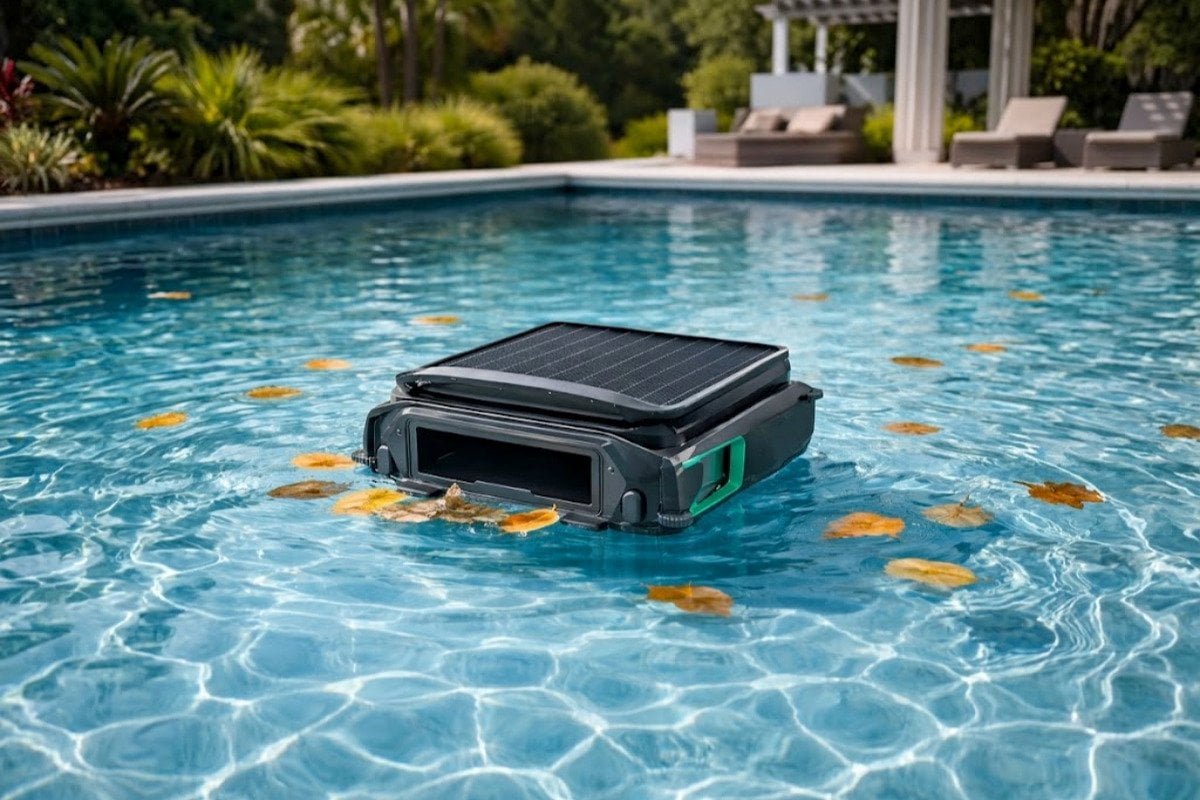
The real debris capture capacity of a skimmer robot comes down to how effectively it moves water (flow rate), filters small particles (micron rating), and stores collected debris (basket size).
What Numbers Actually Tell You
Flow rate represents the volume of water the robot can clean per minute[^4], typically measured in liters (e.g., 300 L/min). Better flow rate leads to faster debris clearance, making it ideal for larger or debris-heavy pools.
Micron mesh size determines how fine the particles caught by the filter will be[^5]—generally, smaller is better for things like algae and dust. For example:
- 100-micron filters handle larger debris like leaves.
- 20–50 micron filters are better for finer pollutants like sand and hair.
Basket size impacts how long your robot can operate before needing to be emptied. The larger the basket, the longer the runtime without manual cleaning interruptions.
How This Plays Out in Practice
One customer complained about needing to empty their pool skimmer robot twice during each cleaning cycle, only to realize they’d chosen a model with a tiny basket (0.5L). Another found that their high-flow-rate robot missed finer particles because of an overly large micron mesh. If you want thorough cleaning with minimal effort, be sure that your model balances flow rate and micron filtration while providing sufficient basket capacity for your pool size.
Durability and navigation technology are the less obvious specs but can make or break a pool skimmer robot’s performance long-term. Materials, sensor accuracies, and compatibility with different pool shapes all matter.
Durability is tied to IPX waterproof ratings and UV-resistant materials, while navigation specs (like sensor precision) define how well the robot adapts to your pool configuration. A mismatch can lead to dead zones or breakdowns.
- IPX Ratings: Check if your model is rated for waterproof submersion (e.g., IPX7 is splash-resistant; IPX8 can operate underwater).
- Anti-UV Materials: For outdoor pools, UV-resistant plastics extend the lifespan. Without them, exposure to sunlight causes brittleness and cracks.
- Navigation Sensors: Terms like “smart navigation” may include specific sensors (e.g., gyroscopes, obstacle avoiders) or mapping software. Ask if the navigation system reliably covers edges and corners, as these are common trouble spots.
Why Pool Compatibility Matters
I once advised a customer with a kidney-shaped pool to avoid models built for rectangular tank navigation. They were frustrated by persistent dead zones until switching to a sensor-equipped robot better suited to irregular shapes. Consider your pool’s features: curved edges, steps, or larger areas need adaptable navigation tech.
Frequently Asked Questions
What’s the most overlooked specification on robotic pool skimmers?
Many buyers overlook micron mesh size, but it’s one of the most critical specs for achieving clean-looking water. Without it, your robot could miss algae, fine sand, or other particles that make water cloudy. Always check this rating.
How long should a robotic pool skimmer run for an average-sized pool?
For pools under 10 meters long, aim for a runtime of at least 6–8 hours per charge[^6]. Smaller runtimes (like 2–3 hours) typically require multiple cleaning cycles each day, adding inconvenience.
Are IPX ratings essential for solar-powered pool skimmers?
Yes—although these robots spend most of their time floating, water exposure is constant. Without a minimum IPX7 rating, the electrical components could fail quickly[^7]. Higher IPX ratings (e.g., IPX8) are strongly recommended.
Conclusion
Understanding pool skimmer robot specifications doesn’t have to feel like decoding hieroglyphs. Focus on the practical elements—solar wattage paired with battery capacity, filtration paired with debris storage, and durability paired with navigation compatibility[^8]. These specs not only determine performance but also ensure the robot fits your specific pool's needs.
Take time to evaluate the primary specs carefully before buying. This avoids overspending on features you don’t need and ensures your pool skimmer meets real-world expectations. Ready to upgrade your pool cleaning game? Let’s dive into smarter choices.
[^1]: "Is There a Robot in Your Future? Helen Greiner Thinks So", https://knowledge.wharton.upenn.edu/podcast/knowledge-at-wharton-podcast/is-there-a-robot-in-your-future-helen-greiner-thinks-so/. Studies on consumer behavior indicate that vague or exaggerated marketing terms can lead to misconceptions about product performance, particularly in technical categories like robotics. Evidence role: expert_consensus; source type: research. Supports: Marketing terms can obscure the actual capabilities of pool skimmer robots.. Scope note: Specific examples for pool skimmer robots may vary by manufacturer. [^2]: "Improving battery charging with solar panels", https://repository.library.northeastern.edu/files/neu:1434/fulltext.pdf. Solar panel wattage is a measure of the maximum power output under ideal conditions, which directly influences charging speed when exposed to full sunlight. However, environmental factors like temperature and panel efficiency also play significant roles. Evidence role: mechanism; source type: education. Supports: Solar panel wattage determines the speed of charging in direct sunlight.. Scope note: The relationship assumes ideal sunlight conditions and does not account for variations in panel technology or shading. [^3]: "Monitoring Aquatic Debris Using Smartphone-Based Robots", https://cse.msu.edu/~liuxm/publication/TMC-2014-08-0414.R1_Wang.pdf. Debris density increases the workload on filtration systems, while moving components like motors and sensors contribute to higher energy consumption, both of which reduce runtime. Evidence role: mechanism; source type: research. Supports: Debris density and moving components' power draw significantly affect the real-world runtime of pool skimmer robots.. Scope note: Specific impacts vary by robot model and operational settings. [^4]: "(PDF) Robotic Pool Cleaning Machine Using Arduino", https://www.academia.edu/109186102/Robotic_Pool_Cleaning_Machine_Using_Arduino. Flow rate is defined as the volume of fluid passing through a system per unit of time, typically measured in liters per minute (L/min) for pool cleaning devices. Evidence role: definition; source type: encyclopedia. Supports: Flow rate measures the volume of water a pool skimmer robot can clean per minute.. Scope note: This definition does not account for variations in flow rate due to debris clogging or pump efficiency. [^5]: "(PDF) Mesh vs. Micron Comparison Chart", https://www.academia.edu/23028695/Mesh_vs_Micron_Comparison_Chart. Micron mesh size refers to the diameter of the openings in a filter, with smaller micron ratings capturing finer particles. For example, a 20-micron filter can trap particles as small as 20 micrometers. Evidence role: definition; source type: education. Supports: Micron mesh size determines the fineness of particles captured by the filter.. Scope note: Effectiveness depends on the filter material and water flow rate. [^6]: "Robotic Pool Cleaner,Cordless Automatic ...", https://reframedarchives.sandbox.library.columbia.edu/listing/robotic-pool-cleanercordless-automatic-pool-cleaner-with-210?srsltid=237313653. Runtime recommendations for robotic pool cleaners are based on pool size and debris levels, with smaller pools typically requiring 6–8 hours for thorough cleaning. Evidence role: general_support; source type: institution. Supports: Pools under 10 meters long require a runtime of 6–8 hours per charge for effective cleaning.. Scope note: Specific runtime needs may vary based on debris density and robot efficiency. [^7]: "Evaluation of IEC 60529 as a standard for liquid protection ...", https://phm.skku.edu/bbs/link.php?bo_table=sub3_1&wr_id=52&no=2&page=1. IPX7-rated devices are designed to resist temporary water immersion, reducing the risk of electrical failure in environments with constant water exposure. Evidence role: mechanism; source type: research. Supports: Pool skimmer robots without a minimum IPX7 rating are at risk of electrical component failure.. Scope note: Long-term durability depends on additional factors like material quality and maintenance. [^8]: "An autonomous pool cleaner", https://courses.grainger.illinois.edu/ece445zjui/getfile.asp?id=21344. Combining complementary features, such as solar wattage with battery capacity, enhances overall efficiency and usability in robotic pool cleaners. Evidence role: general_support; source type: education. Supports: Pairing solar wattage with battery capacity, filtration with debris storage, and durability with navigation compatibility ensures optimal performance.. Scope note: Effectiveness depends on the specific model and pool conditions.
Related Posts
How to Evaluate a Robotic Pool Cleaner Sample Before Mass Production?
# How to Evaluate a Robotic Pool Cleaner Sample Before Mass Production? When assessing a robotic pool cleaner sample before…
How to Measure Pool Skimmer Cleaning Coverage in a Repeatable Test?
# How to Measure Pool Skimmer Cleaning Coverage in a Repeatable Test? [Pool skimmer cleaning coverage is one of the…
What Warranty Terms Should Buyers Compare for Robotic Pool Cleaners?
# What Warranty Terms Should Buyers Compare for Robotic Pool Cleaners? When buying robotic pool cleaners, warranty terms can heavily…
Leave a Reply